Your body's own cannabis-like network.
You don't need to have ever touched cannabis. Your body makes its own version of cannabis-like signaling chemicals — and uses them to help regulate mood, the urge to socialize, inflammation, memory, and pain.
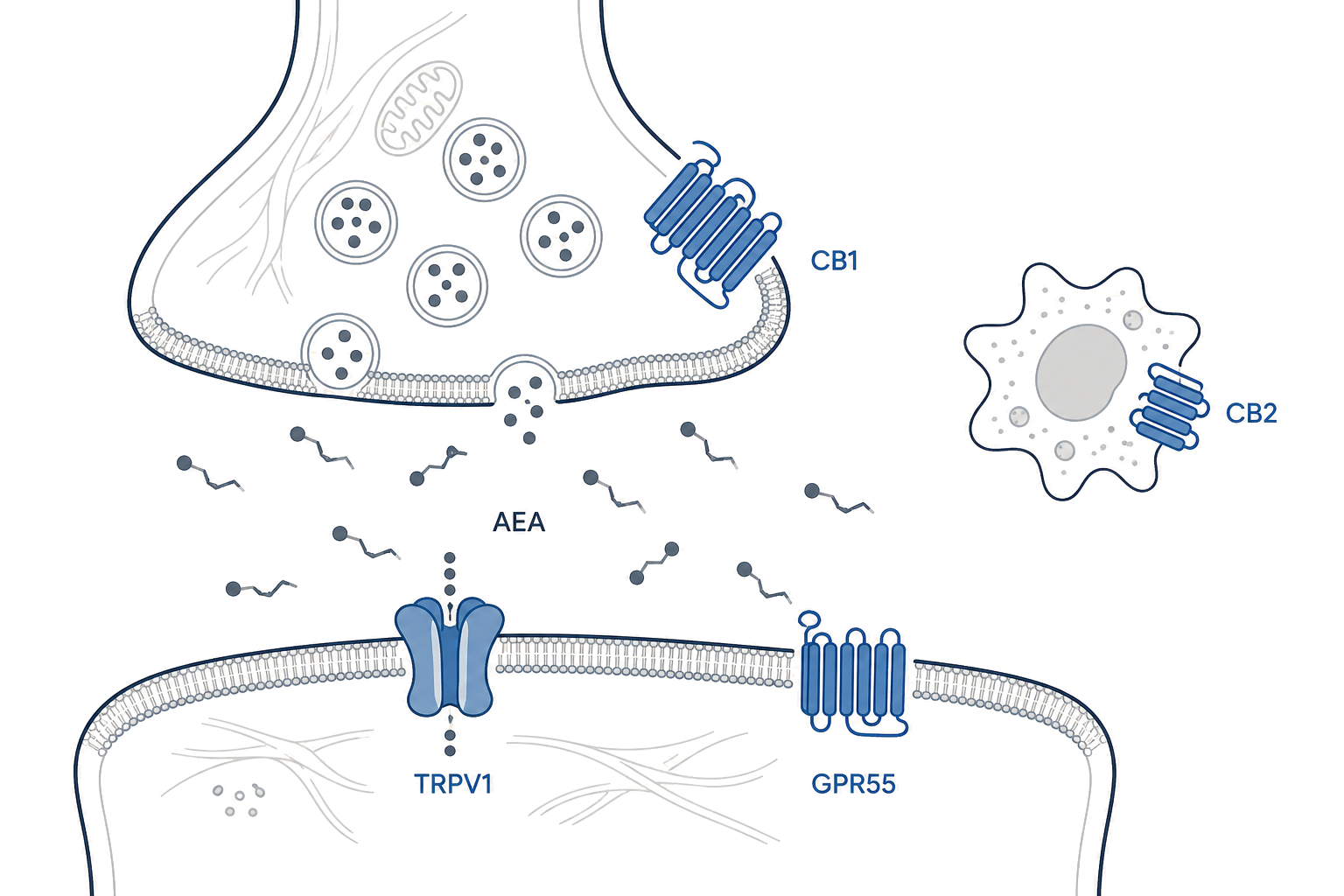
The system has a name — the endocannabinoid system, or ECS for short — and it has three parts that matter for understanding what's going on. First, there are signaling chemicals the body makes itself. The most famous is called anandamide, sometimes nicknamed the "bliss molecule." Second, there are tiny structures on the surface of cells that respond to these chemicals — the body's receivers. And third, there are enzymes whose job is to build the signaling chemicals up and break them down again as needed.
This whole system runs quietly in the background of every typical day. It's part of why a hug feels good, why you can sleep, why injuries don't hurt forever. The cannabis plant happens to make compounds that act on the same receivers — which is why cannabis affects mood, sleep, pain, and a long list of other things. THC, CBD, and CBDV all interact with this same family of biology, but each one acts on a different part of it.
How it runs differently in autistic children.
Two separate research labs — one at Stanford, one in Israel — both measured lower levels of these natural cannabis-like signaling chemicals in autistic children. Same finding, two countries, two different populations.
The first study, from a Stanford group in 2018, measured anandamide levels in the blood of 112 children — some autistic, some not. The autistic children had significantly lower levels. The difference held up after controlling for age, sex, weight, and any medications the kids were taking. It was the first human evidence that the system CBDV acts on is genuinely different in autistic kids.
The second study, from a different research group in Israel a year later, replicated and extended that finding. They measured anandamide and two related signaling chemicals in 93 children and found all three were lower in autistic children than in their non-autistic peers. Two independent labs. Two countries. Different methods. Same answer.
Animal research strongly supports this picture too. In one of the most-validated rat models of autism, raising the level of natural endocannabinoid signaling — using a different drug, but the same biology — rescued social behavior, reduced anxiety, and improved cognitive function across multiple developmental stages.
Together, these findings make a specific case: this isn't about treating autism with "cannabis." It's about gently nudging a specific biological system that, in autistic children, is measurably running differently.
How CBDV works on this system.
CBDV doesn't act on the same parts of this system that THC does. It uses a different set entirely — and behaves more like a buffer than a switch.
If you map this system out, the most familiar piece is the receiver that THC activates to produce a high. CBDV barely interacts with that one — which is why CBDV produces no psychoactive effect at all. Instead, CBDV acts on a different set of receivers in the brain, ones that handle calcium flow into nerve cells.
The interesting feature of how CBDV interacts with these receivers is what scientists call "activate-and-desensitize." Functionally, this means CBDV briefly opens the door — letting some calcium in, signaling activity — and then quickly closes it back down again, leaving the door temporarily unable to respond. The result is a quieting of nerve cells that have been firing too actively.
This pattern is consistent with what the brain-imaging studies in autistic adults show. CBDV doesn't sedate everyone uniformly. It specifically softens what's running too hot — moving each person toward the middle. That's exactly what an "activate-and-desensitize" mechanism would produce: quieter nerve cells in regions that had been over-firing, with little effect on regions that were already running normally.
It also explains why CBDV is being separately developed as an anti-seizure compound. Roughly a third of autistic people experience seizures or seizure-like activity on EEG. The same mechanism that makes CBDV calming for autism also makes it useful for stopping the runaway over-firing that produces seizures. One compound. Two related uses. Same underlying biology.
Treating it isn't a guess.
CBDV doesn't act on a generic system. It acts on the specific one that, in autistic children, is measurably running differently from typical. That's why this approach is being taken seriously.
The strongest human evidence isn't a single study — it's two, on two continents, finding the same difference. The biology is real. The question now is whether gently nudging it produces the kind of day-to-day improvement families actually need.
What we have so far: a measurable biological difference, replicated across labs. A compound (CBDV) that engages that biology in a specific, well-characterized way. Animal models showing that engaging this biology rescues autism-like features. Brain-imaging studies in autistic adults showing CBDV moves brain activity toward more typical patterns. And a major pharmaceutical company that has staked its claim — confident enough to pursue the regulatory and intellectual-property scaffolding for a future medication.
What we don't yet have: clinical trial data in children. That's the trial that's underway now.